The Cost of Making by Hand
For most people, the price of silver is probably one of those things that barely registers unless they’re buying jewelry or watching the financial news. For me, it has quietly lived in the background of my business for more than twenty five years.
Back in 1999, when I first started making jewelry, I also did something that now feels both wildly nerdy and deeply practical. I taught myself just enough Excel to build a cost analysis spreadsheet for my work. And when I say “taught myself,” I mean in the truly late-1990s PC-computer way where you clicked buttons until something worked and then prayed you never broke it again. I created formulas and key codes so I could change the cost of raw materials and have the spreadsheet automatically recalculate the true cost of every style I made. At any given moment, I could see my margins, material costs, and whether my pricing structure still made sense.
I’m honestly still very proud of that spreadsheet. It wasn’t elegant and it certainly wasn’t sophisticated, but it worked. And over the years, it became part of the rhythm of running my business.
Twice a year, in January and June, I revisit all of my raw material costs and compare prices from multiple suppliers. I buy most of my metals from Rio Grande in New Mexico, though there are several other suppliers and I do check against them every time. It’s just part of the discipline of staying in business. Materials change. Shipping changes. Markets change. You pay attention and adjust accordingly.
When I first started, pure silver hovered somewhere around $4 a troy ounce. It mattered, of course, but it wasn’t dramatic. The largest expense in my work has always been the dichroic glass itself. Silver was simply one component among many.
Then around 2005 silver slowly crept upward. $10ish an ounce became normal. After the economic crisis in 2008, it jumped again into the $20 range and, like so many things, never really came back down. It settled into the high twenties and low thirties and stayed there long enough that it began to feel stable again. Or at least predictable.
And predictability matters when you run a small business. Not because you expect things to stay the same forever, but because you need enough consistency to make decisions. You need to know whether your pricing still works. Whether your margins are healthy enough. Whether the thing you are making with your own two hands is still actually supporting your life.
By 2023 silver was still living in the low $20’s. In 2024 it started creeping upward again, into the $30’s, while at the same time the price of dichroic glass began increasing too. I revisited my spreadsheet, recalculated everything, and realized that for only the fourth time in 24 years, I needed to raise my prices.
In June of 2025 silver was somewhere around $35 a troy ounce, I decided to hold steady and move into the summer season knowing my margins were a little thinner than I liked, but still workable.
And then January 2026 arrived. I sat down with my spreadsheet like I always do. Same ritual. Same process. Same quiet review of the numbers. Except this time the numbers looked impossible.
Silver had jumped to $125 a troy ounce.
In less than six months, silver had transformed from a relatively stable raw material into a heavily traded commodity reacting to the economic policies and instability of the United States. And suddenly, this thing that had quietly existed in the background of my business for decades was now demanding my attention almost daily.
This is one of the strange realities of being a very small business owner. Large economic policies and global market shifts don’t arrive as abstract headlines. They arrive as spreadsheets. Purchase orders. Anxiety. Delayed decisions. Thinner margins. Longer workdays.
I haven’t raised my prices again. At least not yet. But I’ve noticed my own behavior changing. I no longer casually order silver when I need it. I watch the market, I hesitate and I second guess timing. Last week silver dipped to around $73 an ounce and I thought, “I should probably place an order.” I didn’t. This week it climbed back to $84.
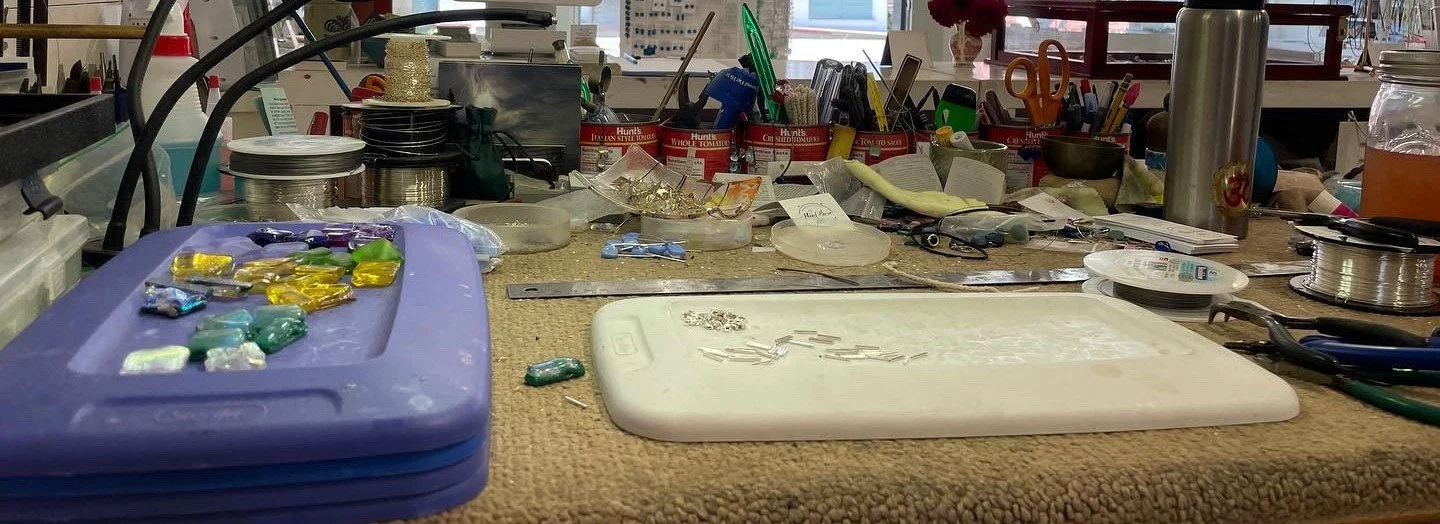
And suddenly I found myself doing something I haven’t done in years. Making my own ear wires again. I had leftover silver wire in the studio and buying premade ear wires suddenly felt extravagantly expensive. So I pulled out my tools and started making them by hand. The first couple felt awkward. Not bad exactly. Just unfamiliar in the way that something once deeply known can become rusty from disuse. And then I closed my eyes. And instantly my hands remembered. Not my brain. My hands. The movement was still there somewhere, stored quietly in muscle memory after all these years -Bend Turn Cut Shape Repeat. Suddenly it felt easy again, familiar and rhythmic.
And honestly, unexpectedly satisfying.
It does take more time. That part is real. Time is part of the cost equation too and I’ll eventually have to sit down and calculate whether making ear wires myself actually makes financial sense once labor is factored back in. But there is also something deeply grounding about handling every component of my work so directly again. About slowing down enough to remember how things used to be made in my own studio before efficiency gradually replaced certain steps.
I don’t know exactly where all of this is headed yet. I’m still figuring it out in real time. But I do know this: running a handmade business for twenty five years means constantly adapting. Sometimes that adaptation looks like spreadsheets and pricing analysis. Sometimes it looks like learning entirely new technology. And sometimes it looks like sitting quietly at your workbench, a length of silver wire in your hands, rediscovering movements your body never truly forgot.