How We Spend Our Days
This morning when I opened my meditation app before sitting, the quote of the day was from Annie Dillard: “How we spend our days is, of course, how we spend our lives. What we do with this hour, and that one, is what we are doing.” And just like that, before I’d even had coffee, I was standing on the edge of Hancock Pond splitting firewood.
Memory is funny that way. It doesn’t arrive in orderly little file folders. It comes rushing in sideways. One sentence, one smell, one song, one particular quality of light, and suddenly an entire season of your life is standing in the room with you. Back then, the house I lived in was heated primarily with wood. The man I was with approached nearly everything through the lens of self-reliance and physical labor. If he could have personally felled trees with an axe while quoting Thoreau under a harvest moon, he probably would have. But since even he had limits, the compromise was having tree-length firewood delivered to the house.
And by tree length, I mean entire lengths of trees. Not neat little stacks of split wood from a roadside stand with a hand-painted “Seasoned Hardwood” sign leaning against them. No. We received enormous lengths of timber which then had to be chainsawed into stove-sized length and split by hand. Fortunately, he operated the chainsaw himself because I have never trusted chainsaws. There are certain tools in this world that I instinctively understand, and there are others that feel like they are one bad mood away from catastrophe. Chainsaws fall firmly into the second category.
Once the wood was cut to length, the rest became part of my life too. The logs would get put on the chopping block and split by hand with a maul. When I first started, I was terrible at it. Truly terrible. I mostly succeeded in denting wood and creating kindling by accident. I couldn’t hit the same place twice to save my life. My swings lacked confidence and follow-through. All my energy stopped at the surface.
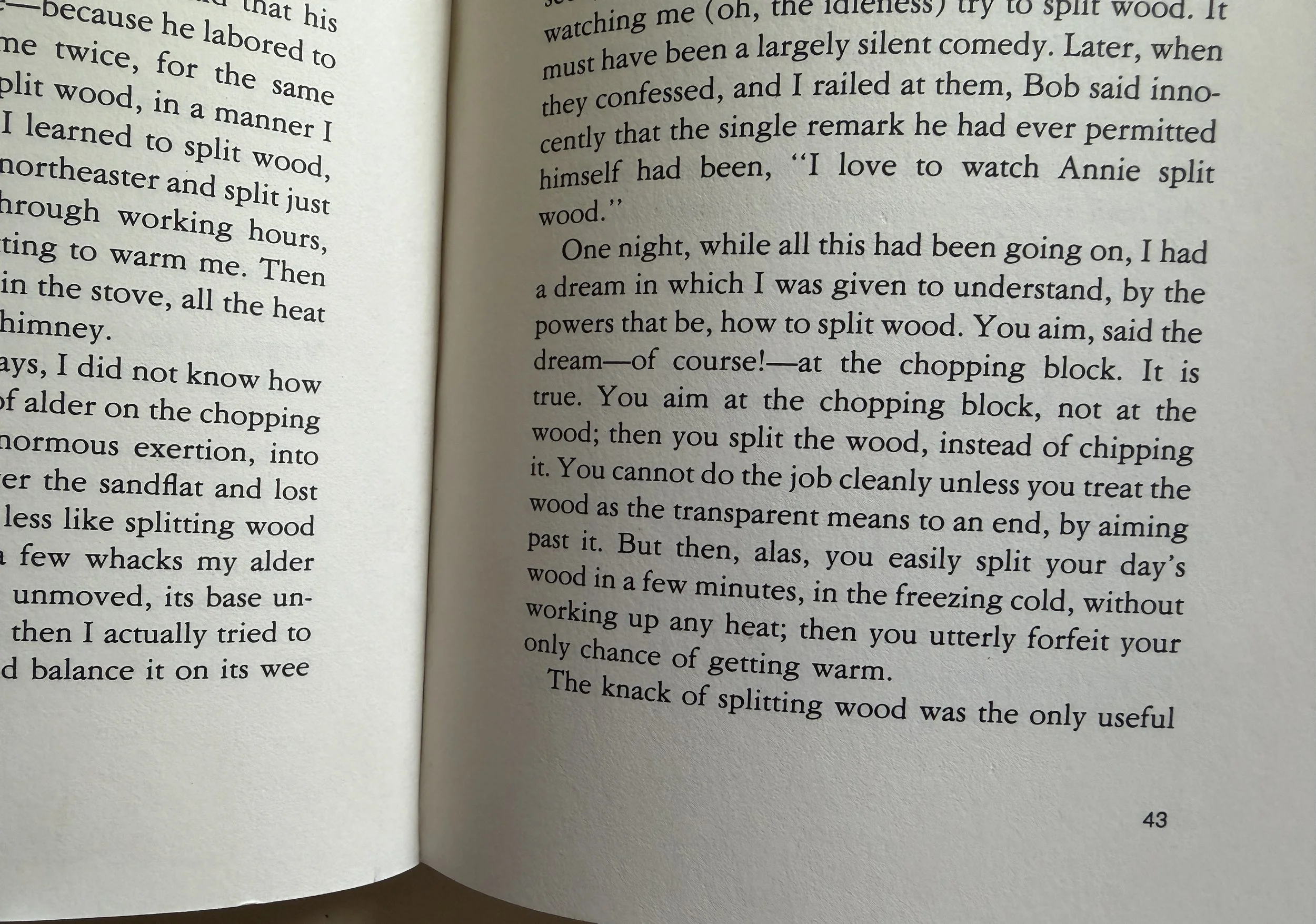
At around that same time, I was reading The Writing Life by Annie Dillard, and one passage in particular settled deep into me. It wasn’t just the practical lesson of it that stayed with me all these years, but the way it opened outward into something larger. Annie Dillard writes:
“One night, while all this had been going on, I had a dream in which I was given to understand by the powers that be how to split wood. You aim, said the dream, of course, at the chopping block. It is true, you aim at the chopping block, not at the wood. Then you split the wood instead of chipping it. You cannot do the job cleanly unless you treat the wood as the transparent means to an end by aiming past it. But then, alas, you easily split your day's wood in a few minutes, in the freezing cold, without working up any heat. Then you utterly forfeit your only chance of getting warm.”
The moment I understood that, everything changed. Instead of aiming at the log itself, I started aiming through it, past it, down into the chopping block beneath it. Suddenly I could split wood. Not elegantly and not with the dramatic confidence of people on TikTok who seem capable of splitting cords of oak while somehow maintaining perfectly clean Carhartt jackets and cinematic camera angles, but enough. Enough to understand the deep satisfaction of striking something cleanly and seeing it open.
But what strikes me now, reading that passage years later, is that the lesson isn’t only about efficiency. In typical Annie Dillard fashion, she immediately complicates the triumph. Yes, aiming through the wood allows you to split it cleanly, but then she turns the whole thing sideways by reminding us that if you split the wood too quickly, too efficiently, you lose the labor itself. You lose the effort that warmed you before the fire ever did.
That feels deeply important in this moment in time because modern life worships efficiency and optimization, constantly urging us to make things faster, cleaner, more productive, more streamlined, and less labor intensive, often without considering that some forms of work are part of what makes a life feel meaningful in the first place. We are constantly encouraged to eliminate effort wherever possible, and certainly there are forms of labor that should be made easier. Some work is exploitative and exhausting and leaves people with very little of themselves at the end of the day. But there are other kinds of effort that nourish us while we are doing them. The labor itself becomes part of the warmth.
There is a particular pleasure in physical work that produces immediate and visible results. The wood either splits or it doesn’t, and because of that there is very little room for ambiguity or abstraction. Unlike so much of modern work life, there are no meetings to schedule, no branding language to untangle, no endless optimization strategies to implement, and no refreshing your inbox wondering whether someone has replied. There is simply the direct relationship between effort, impact, and result. I find myself thinking about that often these days as more and more versions of “simple living” drift across my screens wrapped in linen, filtered light, and acoustic music.
The truth is that traditional labor is not aesthetic. It is relentless. Heating your home with wood is not one charming snowy afternoon spent stacking logs while wearing fingerless mittens and sipping tea from a handmade mug. It is sourcing wood, cutting wood, splitting wood, stacking wood, covering wood, carrying wood, tending fires, emptying ash, cleaning chimneys, planning ahead, and doing it all over again. Gardens are beautiful, but they are also weeding, watering, fencing, hauling compost, battling insects, preserving food, and losing crops anyway. Animals are not quaint lifestyle accessories. They are responsibility tied to weather and time. They need care when you are tired, grieving, busy, sick, overwhelmed, or would rather be doing literally anything else. There’s a reason older generations often moved away from this kind of labor the moment they could.
And yet, there is also something deeply human about participating directly in the maintenance of your own life. I think many people today are starving for that feeling even if they don’t entirely recognize it. We spend so much of modern life in abstraction. Entire days disappear into logistics and administration and algorithms and customer service portals and passwords and updates and things that somehow leave no visible evidence at the end of them. Then you split a piece of wood, knead dough, plant seeds, mend a fence, stack stones, or hang laundry in the wind, and something inside your nervous system exhales. Not because the work is easy, but because the work asks something specific of you. It asks for attention, coordination, patience, endurance, and presence, and your body understands immediately whether you showed up fully or not.
I think that’s part of why these slower and more physical lifestyles hold such emotional power right now. People are exhausted by the pace and fragmentation of modern life. They are hungry for texture, rhythm, and visible evidence that their actions matter. But I also think social media has created a wildly distorted fantasy version of these lives. Many of the people showcasing “traditional living” online are doing so with invisible support structures underneath them: family money, flexible work, a spouse earning the primary income, paid help behind the scenes, sponsorships, film crews, and financial cushions large enough to absorb mistakes and inefficiencies. That doesn’t make them bad people, but it does matter. Historically, people didn’t live this way because it was romantic. They lived this way because survival required it, and survival consumed enormous amounts of time.
The life I was living back then was shaped in part by the flexibility that relationship allowed at the time, and it gave me a firsthand look at a more back-to-the-land way of living that many people now romanticize online. What stayed with me from that period was not wealth or ease, because the reality was far more complicated than that, but the experience of participating directly in the work required to sustain daily life. There is beauty in knowing where your heat comes from, in understanding how long it takes to split and stack enough wood for a Maine winter, and in feeling your body become stronger because daily life itself requires strength. There is beauty in competence and in learning how to care for yourself and your surroundings in tangible ways. But there is also a tendency to forget the hidden mathematics of these lives. Time is the invisible currency underneath almost every handmade, homegrown, back-to-the-land life, and people create that time in very different ways, through money, sacrifice, unconventional choices, hard physical work, or simply deciding that certain things matter enough to build a life around them.
Even knowing all of that, I remain deeply drawn to work that engages the hands and body directly. I suspect I always will be. Part of why I make glass the way I do is because it keeps me connected to material reality. Glass has weight, temperature, timing, and consequence. It breaks if you force it. It responds differently depending on heat and thickness and atmosphere and patience. There’s no way to entirely fake your relationship with a material over time because the material itself keeps telling the truth. Wood does too. So does gardening. So do animals. So does cooking from scratch. So does maintaining an old farmhouse on an island in the middle of Penobscot’s Bay where the weather regularly laughs at your plans.
All of it eventually asks the same question: how do you want to spend your days, not in some abstract or aspirational sense, but in the reality of how you move through your ordinary life each day. A life is not built from ideals alone. It is built from repetition, maintenance, and the things you return to over and over again. It is shaped by what you choose to feed, what you choose to repair, what you practice consistently, and ultimately by what you are willing to tend with your time, attention, and care.
I think what moved me so deeply about seeing that quote this morning is that I remembered Annie Dillard didn’t just teach me something about wood splitting all those years ago. She taught me something about attention. About aiming through the thing instead of stopping at the surface. About understanding that energy dies when it meets resistance unless we learn to carry it past the obstacle. But she also taught something equally important: that not all effort is waste. Sometimes the labor itself is part of what warms us. Sometimes the process we are trying so hard to streamline is actually where part of the living happens.
Maybe that applies to more than wood. Maybe it applies to relationships, creative work, grief, building a business, caring for aging parents, tending animals, and staying engaged with a complicated world instead of retreating from it. Maybe the goal has never been merely to strike the thing in front of us. Maybe the goal is to remain connected to what lies beneath it, and to the deeper reason we are swinging at all.