When people learn that I'm a glass artist, they often picture someone standing in front of a blazing furnace, gathering molten glass on the end of a long pipe and blowing it into shape. Hot glass is certainly one way to work with glass, but it is only one branch of a surprisingly large family tree. Glass artists generally work in one of three broad categories: cold glass, hot glass, and warm glass.
Cold glass is what many people think of as stained glass. In cold-working processes, the glass is cut, ground, polished, foiled, leaded, etched, or assembled without being heated to the point where it melts. The artist works with the glass at room temperature, joining pieces mechanically rather than fusing them together with heat.
Hot glass, often called blown glass, takes things a step further. The glass is heated until it becomes molten and fluid. Artists gather the molten glass from a furnace and shape it through a combination of breath, gravity, tools, and skill. Watching a skilled glassblower work feels a little like watching a dance between the artist and the material.
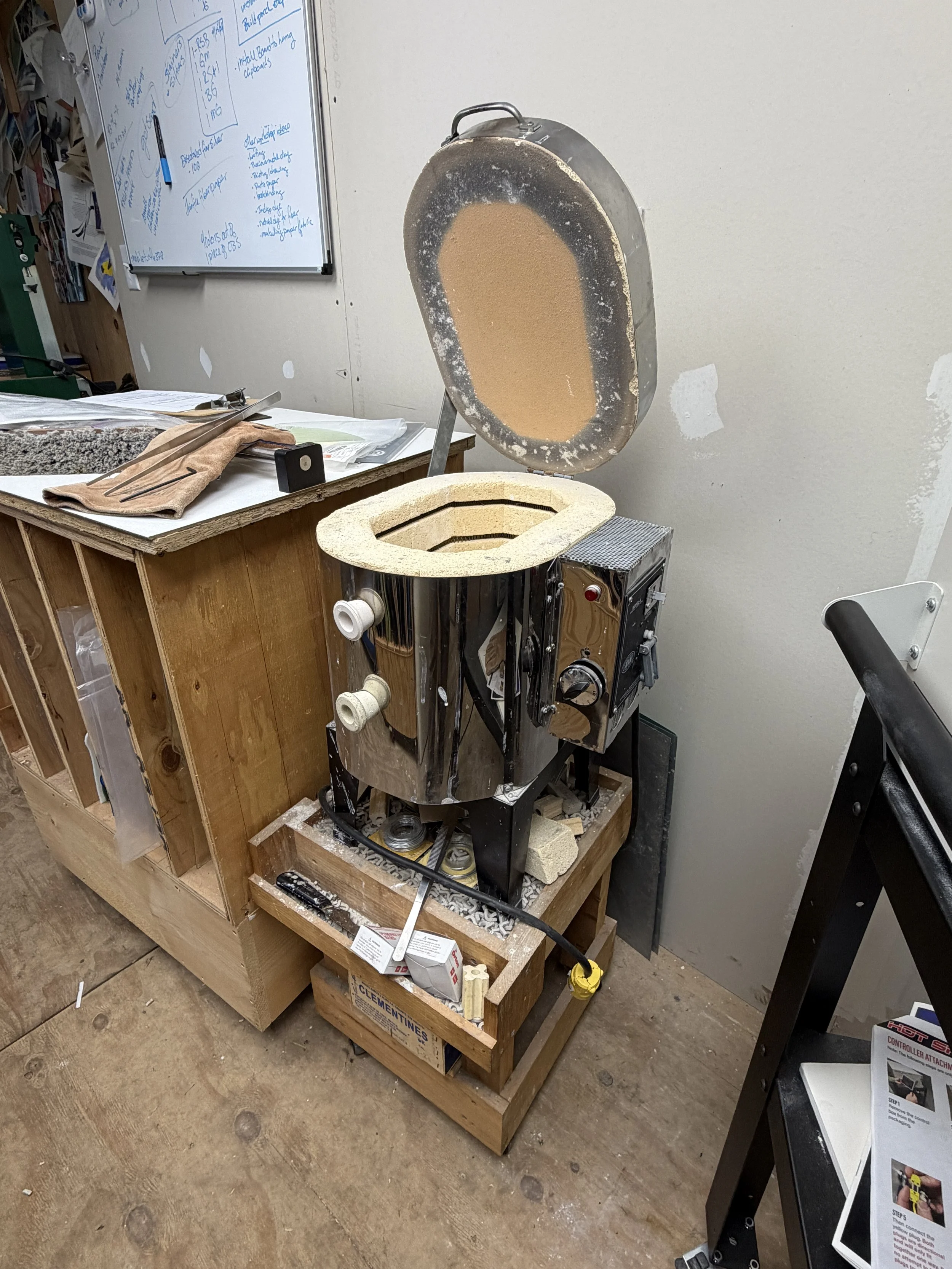
Warm glass is the world I inhabit. Warm glass is often called fused glass or kiln-worked glass. In this process, sheets of glass, glass powders, frits, stringers, and other glass materials are arranged and then heated inside a kiln until they soften and become one piece. Depending on the temperature and firing schedule, the glass can simply fuse together, slump into a mold, or be shaped in countless other ways.
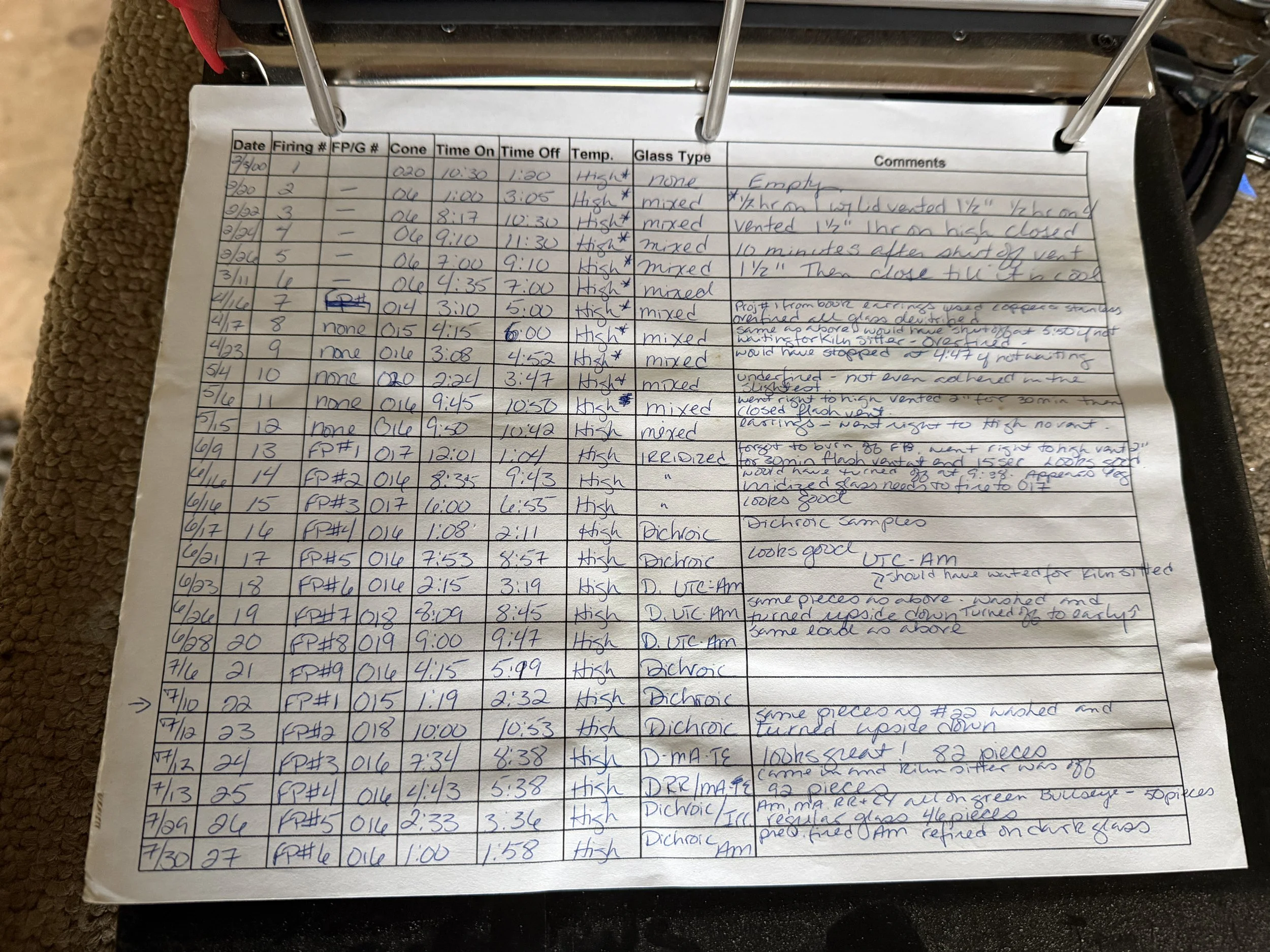
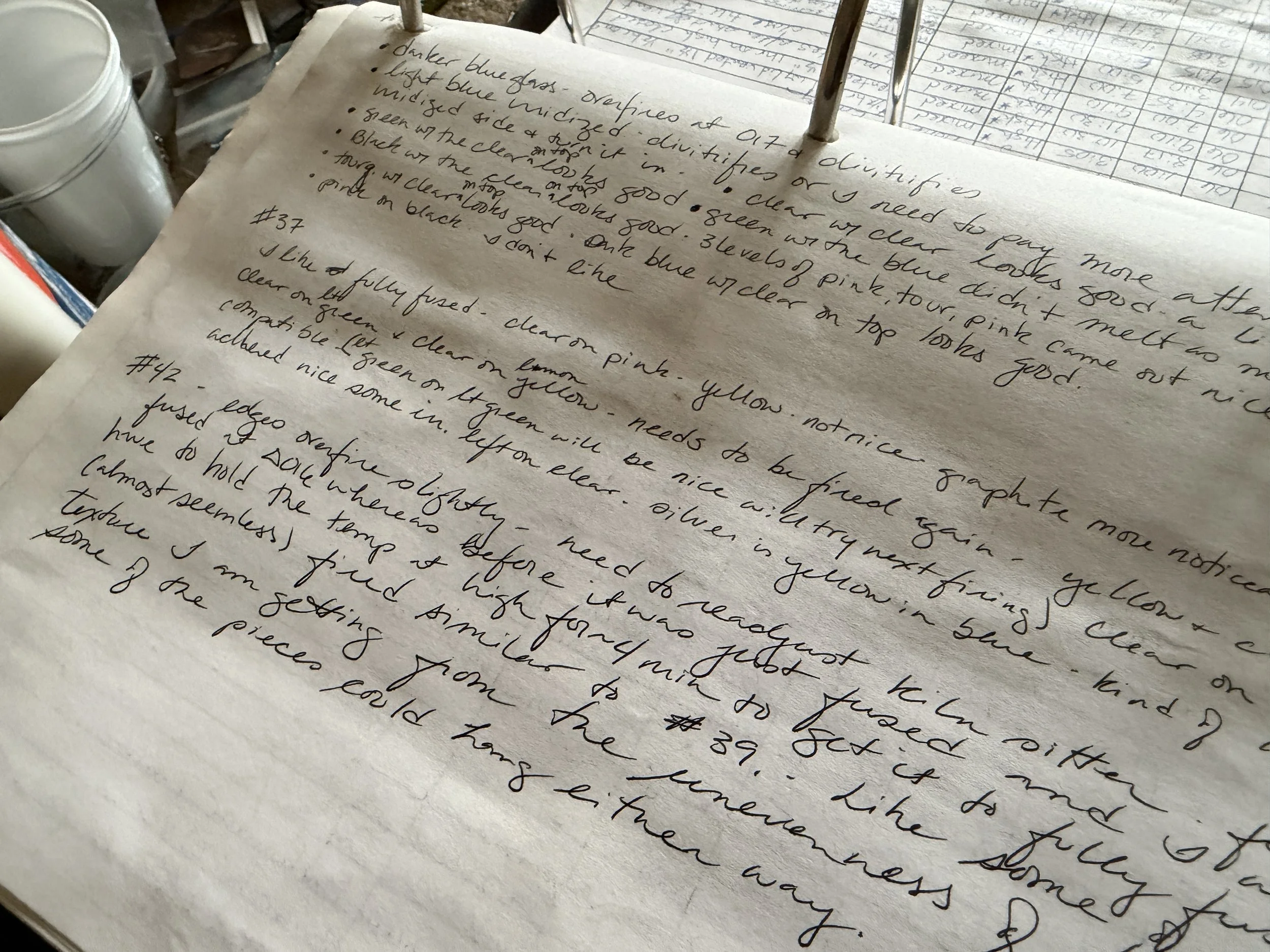
When I began exploring fused glass, I had the good fortune to become friends with a potter who introduced me to kilns in an entirely different way. He taught me about firing schedules, heating rates, cooling rates, and the importance of observation. More importantly, he taught me to keep records. Of all the lessons he shared, the one that stayed with me was simple: keep a firing log and record everything. The kiln is always teaching, but only if you are paying attention. The kiln that started it all is a small Olympic ceramic test kiln with a kiln sitter, as I write this it has been fired 2,867 times, and it is still quietly doing the work it was built to do.
A few years ago, I added a second kiln, a newer version of the first. This one came equipped with a computerized controller, which felt like stepping into an entirely new world. Suddenly schedules could be programmed with precision, and the kiln could manage complex firing cycles on its own. It has now completed 412 firings and has become a dependable part of my studio.
Recently I added a large kiln specifically designed for glass and it had been giving me trouble after only 23 firings. With a bit of troubleshooting, I discovered the culprit was a faulty pyrometer. Replacing it meant opening up the inside of a piece of equipment that costs considerably more than my first car, which was equally educational and nerve-racking. Thankfully, I wasn't on my own. The team at Hot Glass, the kiln manufacturer, provided excellent customer service and patiently walked me through the troubleshooting and repair process step by step. Their guidance gave me the confidence to tackle the repair, and I'm happy to report the kiln is now working like new.
One of the things that first fascinated me about glass is that it refuses to fit neatly into categories. Although we tend to think of glass as a solid, it is what scientists call an amorphous material. Glass occupies its own unusual state, capable of softening and flowing when heated and becoming rigid again as it cools. Different types of glass do this at different rates. If those rates don't match, problems begin to develop. Glass artists often refer to this property as the Coefficient of Expansion, usually shortened to COE.
In simple terms, the COE tells you how a particular glass responds to heat and cooling. If I fuse two pieces of COE 90 glass together, they are designed to expand and contract at roughly the same rate. They move through the firing process together. If I try to fuse a piece of COE 90 glass with a piece of COE 96 glass, however, I am asking for two different materials to behave as though they are the same when they are not. One piece wants to expand and contract at one rate while the other wants to move at another. Internal stress develops and sometimes the piece cracks immediately and sometimes it survives the firing and fractures later - maybe weeks or even months later.
One of the reasons I have remained fascinated by kiln-worked glass for nearly three decades is that it sits at this intersection of art, craft, science, and curiosity. Every firing is part experiment, part engineering project, and part leap of faith. You can understand the principles, plan carefully, and still discover something unexpected when the kiln opens.
Of course, paying attention doesn't prevent mistakes, it simply helps you understand them. Looking back through more than 3,300 firings, I can think of only three occasions when a piece was truly lost and had to be discarded. One occurred when a kiln sitter failed and the kiln continued firing far beyond its intended temperature. The glass became severely overfired, and the surface developed devitrification, a cloudy crystallization that can occur when glass is exposed to excessive heat. Other lessons came earlier in my career when I was still learning about glass compatibility. A few cracked pieces taught me that glass may look the same to the eye while behaving very differently inside the kiln. Early on I made the decision to only have COE 90 in my studio, so that was one less thing for me to track. Every mistake left a trail of clues, and every clue found its way into my notebooks.
When I look back over the past 26 years, what I realize is that the kiln logs sitting on my shelves are not really technical documents. They became part technical manual and part diary, documenting successes and failures and a fair number of welcome surprises. After more than 3,300 firings, I still find myself learning from every firing. No matter how much I think I know, there is always something new to notice.